


Table of Contents
Designing What You Know
Module 9 of the OfG course was: An image campaign for a town or region. Design a logo, develop slogans, and create three advertisements.
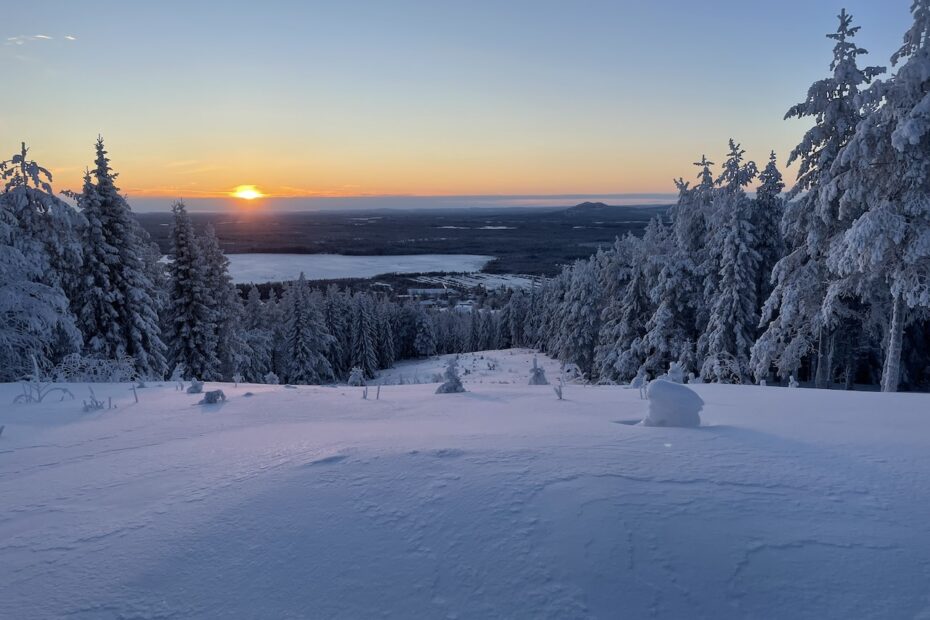
I could have chosen any town for this assignment. I decided on Glommersträsk—the village in Swedish Lapland where I live.
The reason is simple: it is easier to make the unique character of a place visible when you experience it yourself. I know the long winters, the bright summer nights, the silence of the forests, and the vastness of the landscape. The more time I spend here, the better I understand what makes this place so special.
When you are passionate about something, you often notice the details that remain hidden to others. It was exactly this atmosphere that I wanted to capture in the campaign. Not the Lapland from travel brochures, but Glommersträsk as I experience it.
That is an advantage—but also a responsibility. Because its strength does not lie in spectacular attractions or big promises, but in the peace, the nature, and the feeling that here, things are allowed to slow down.
What an Image Campaign Should Achieve
An image campaign for a region has a difficult task: it must be appealing and remain honest at the same time. Advertising doesn’t lie—but it chooses. The question is what you show and what you leave out.
From the very beginning, I decided against loud tourism advertising. No superlatives. No “discover untouched Lapland!” Instead, a subtle, honest image—for people with a longing for deceleration and authentic nature.
The claim summarizes this in four words:
Nära naturen. Nära livet. (Close to nature. Close to life.)
Two sentences, three words each. That is really all it takes.
The Logo: A Piece of Topography
Designing the Glommersträsk logo was particularly enjoyable for me. It was another opportunity to apply what I learned from the modules on logo design and corporate design to a realistic project.
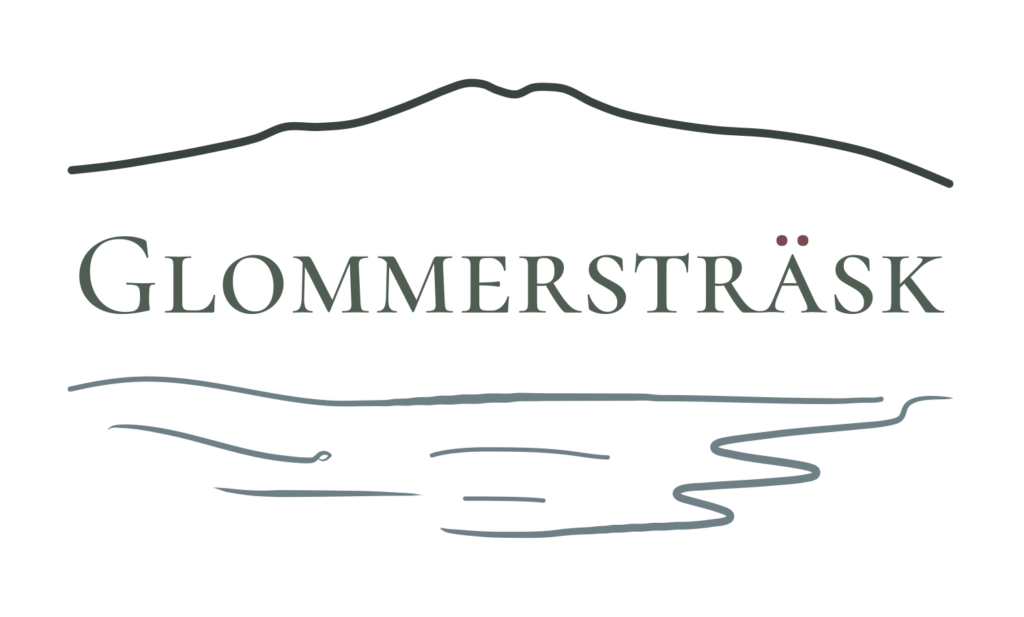
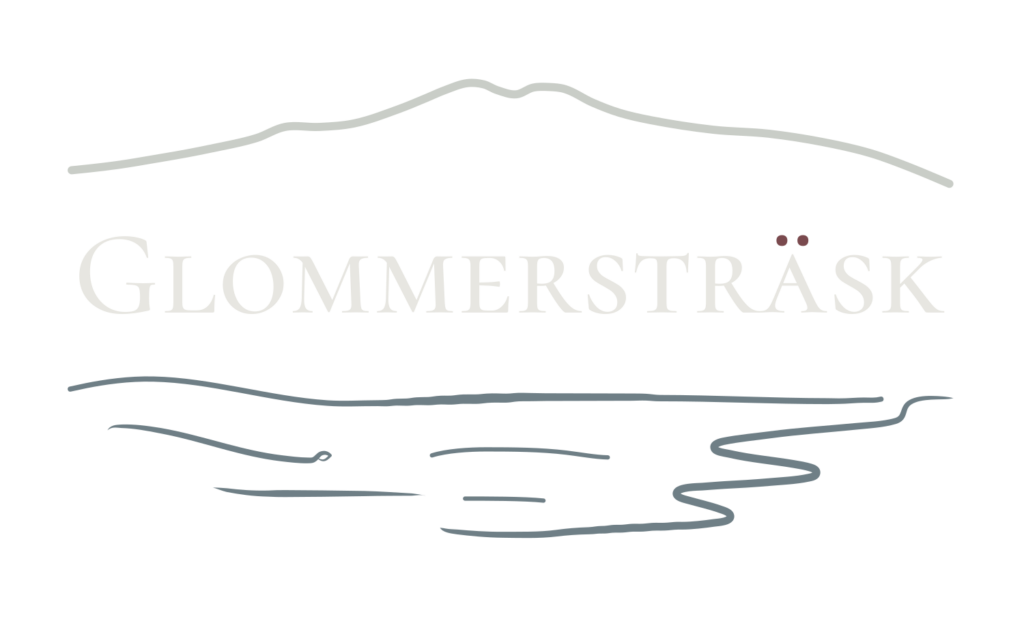
The inspiration came from the Glommersbygden website—there is a picture showing the mountain silhouette behind the village. I took this silhouette and abstracted it into a logo.
The structure follows the actual topography of the place: at the top, the silhouette of the hill; in the middle—where the forest extends—the “Glommersträsk” lettering; and at the bottom, the water lines representing the lake (the “Träsk”). The logo is inextricably linked to the location. Its forms are derived directly from the landscape.
One detail that was important to me: the two dots of the “ä” are set in the accent color—a warm earth tone that brings a human touch to the otherwise cool, moss-green composition.
The feedback noted that the lines turned out a bit delicate overall—the logo could have stronger line work and be slightly larger. That is true. Usually, I struggle with the opposite: too many elements, too little white space, too much at once. For this project, I consciously tried to be more minimalist. In the case of the logo, this may have resulted in the lines becoming a bit too fine.
Colors and Typography: The Palette of Swedish Lapland
The color palette was not created at a screen, but outside in the landscape:
#3A4240 – the cool dark gray of rock and forest edges#4F5D52 – a calm moss tone for the typography#6F7F86 – the muted blue-gray of the lakes#8B6B4E – earth tone, wood, peat; the human element#F2F1EC – almost white, like snow, like vastness, like silenceI deliberately avoided pure, saturated colors. The palette is oriented toward the colors of mist, water, bog, and forest—not a travel brochure.
Typographically, I am working with two fonts: Cormorant SC for the logo lettering (classic, Nordic, timeless) and Lora for slogans and body text (modern, friendly, legible). A balance between identity and emotion.
Three Posters, Three Facets
The three advertisements follow the same design principle: generous white space at the top and bottom, a central photo, a concise slogan within the image, and the claim and logo at the bottom edge. And at the top, detached from the logo, the name of the town—prominent and immediately recognizable.
The illustrations accompanying the town name—stylized birds, northern lights, and a husky—pick up the theme of each respective advertisement. I liked the idea of not just setting the town name in type, but connecting it visually with the motif.
Poster 1 – “Där stillheten bor.”
(Where silence lives.)
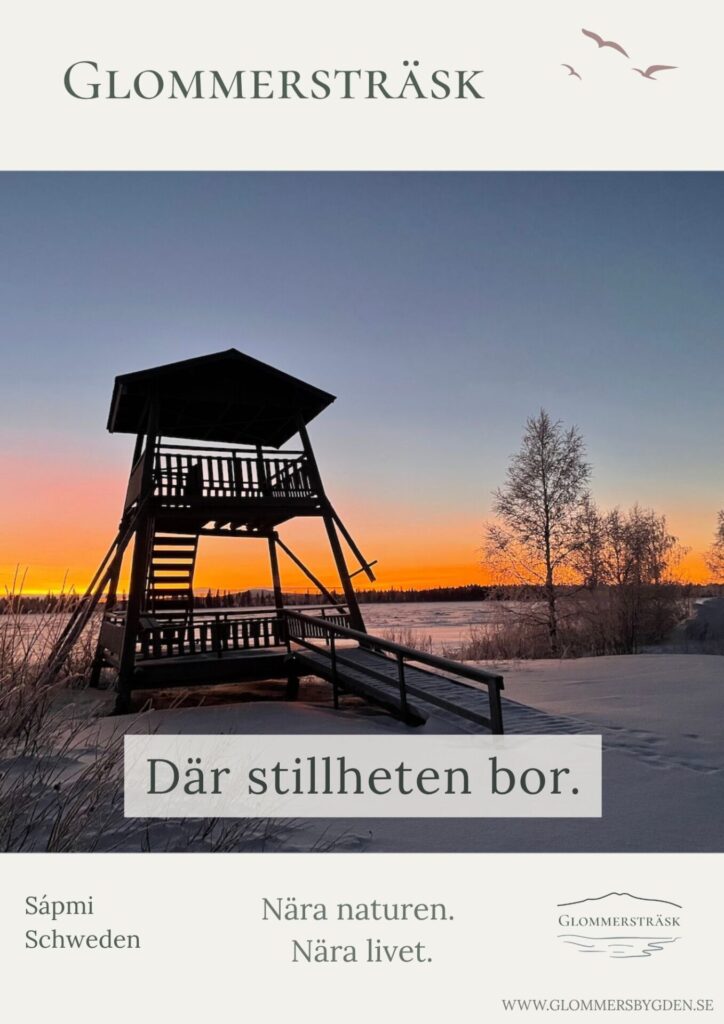
A birdwatching tower on the shores of the Träsk at dusk. Orange sky, frozen lake, snow. The image needs no commentary—but the slogan gives the feeling a name.
Poster 2 – “Där vintern är vinter.”
(Where winter is winter.)
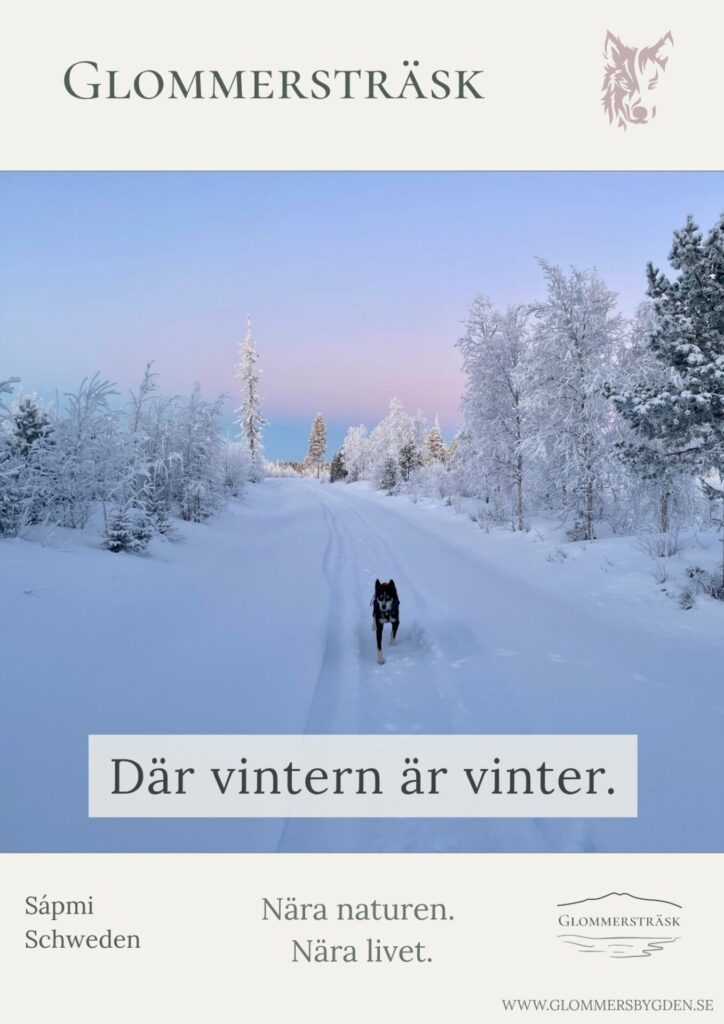
This poster is the most personal one. The dog in the photo is Ayla. The picture was taken on a nearby forest path, in the middle of a deeply snow-covered, untouched landscape. It wasn’t a staged photo—it was a morning in January.
The slogan says what the image shows: here, winter is not just a bit of cold and a wet, gray sky. Here, winter is winter.
Poster 3 – “Där himlen dansar i tystnad.”
(Where the sky dances in silence.)
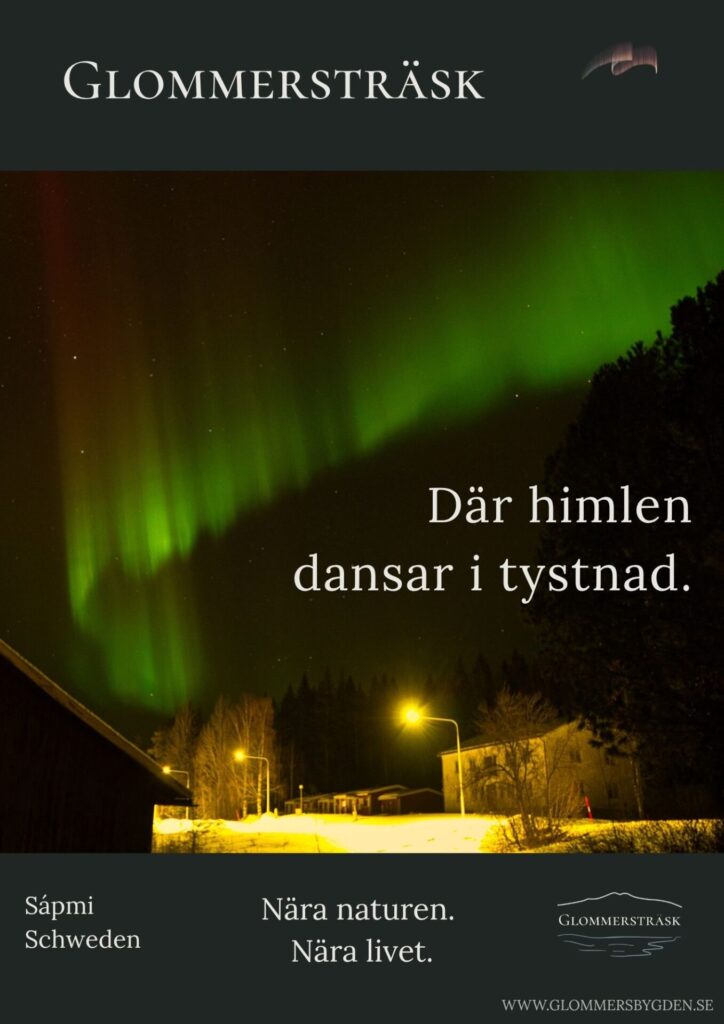
The most spectacular motif—but not staged as a spectacle. Northern lights over rooftops and streetlights. No lonely mountain panorama, no classic tourist backdrop, but the aurora over everyday life. That is also the reason for the darker layout of this advertisement: image and text become a single unit.
“Dansar i tystnad”—dances in silence. This is not a contradiction. It is exactly what you experience when you stand outside at night and watch.
The Eyecatchers: What Worked – and What Didn’t
Each advertisement has a small illustration in the top right corner as an eyecatcher—thematically matching the poster. For Poster 2, I initially wanted something special: instead of an abstract animal motif, an illustration of Lina.
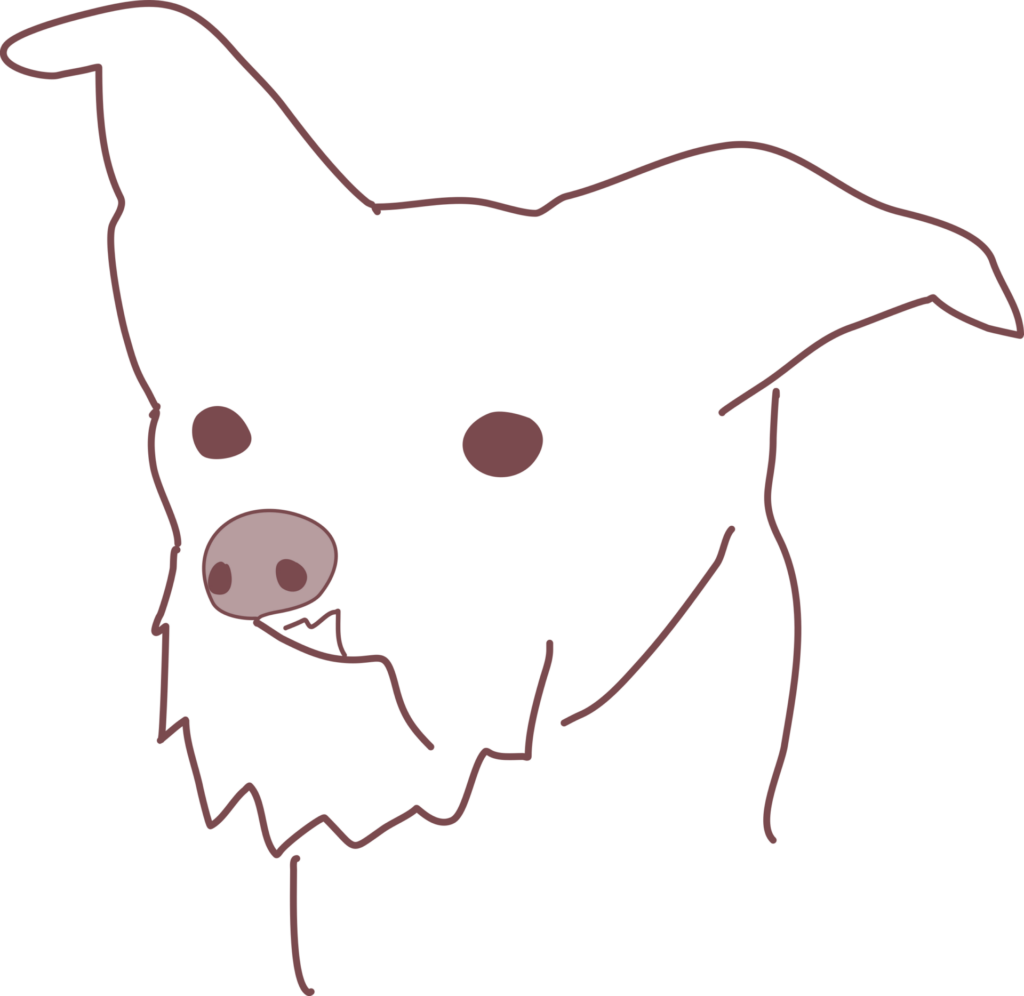
The drawing exists—and it has character. However, as a small element in the upper right of the poster, it didn’t work. The details were too fine and got lost in the small-scale representation. That is why I ultimately decided on a husky, whose silhouette is immediately recognizable and fits well with the Nordic atmosphere of the campaign.
I kept the illustration of Lina anyway. It is too beautiful to disappear.
The Feedback
The feedback on the work was overall positive. The atmospheric photographs, the clear structure of the advertisements, and the illustrations accompanying the town name were particularly highlighted. Above all, the interplay of these elements was perceived as harmonious.
At the same time, there were some suggestions for further development: the lines of the logo could be bolder and the logo itself more prominent overall. Also, the colored areas behind the headlines could be used more sparingly to allow the photographs to have a stronger impact.
I can certainly relate to these comments. With the logo, I was deliberately restrained—perhaps too much so. And with the headlines, I opted for more background area in favor of readability than was ultimately necessary.
I also found the suggestion to submit the prompts used when working with AI tools interesting. This is understandable; at the same time, I rarely perceive creative work with AI as the result of a single prompt. For me, it is more of an iterative dialogue—a sparring partner for ideas, phrasing, or perspectives. However, the design decisions, illustrations, and final executions are made and created by me. A single prompt would only incompletely reflect this process.
My Conclusion
This assignment was the most personal one in the OfG course so far—not because it was particularly emotional, but because I was designing something that is familiar to me and means a lot.
What I have taken away: authenticity is not a method. It arises when you design what you know. And sometimes the strongest slogan is the one that states the obvious—because everyone feels it, but no one has said it that way.
Där vintern är vinter. That sounds like nothing. And like everything.
The next stop: screen design—and with that, back to the website you are currently reading. 😉